























What Is the Difference Between Cannabis Indica and Sativa
The terms “indica” and “sativa” are everywhere in the cannabis world. They appear on seed packs, dispensary menus, grow guides, and strain reviews, often used as a quick way to describe how a plant looks, grows, and feels. Yet, despite how common these labels are, the real differences between indica and sativa are more complex than simple “body high vs head high” stereotypes.
This article takes a closer look at what actually separates indica and sativa: their botanical history, morphology, growth patterns, aromas, and the way modern science views their effects. By the end, you will better understand what these categories really mean—and where their limits are.
Understanding Cannabis Taxonomy
To grasp the difference between indica and sativa, it helps to start with the basics of cannabis taxonomy—how scientists have historically classified the plant.
In the mid-18th century, Swedish botanist Carl Linnaeus was the first to formally describe the cannabis plant. Working with European hemp crops, which were grown mainly for fibre and seed, he believed cannabis to be a single species and named it Cannabis sativa L.. These plants were tall, fibrous, and not especially notable for their psychoactive properties.
Several decades later, in 1785, French naturalist Jean-Baptiste Lamarck studied cannabis plants collected from India. These plants looked and behaved differently from the European hemp that Linnaeus described. They were shorter, bushier, and produced resin that was clearly more intoxicating than hemp. Lamarck classified them as a separate species, naming them Cannabis indica Lam.. In his description, he noted that while these plants made poorer fibre, they were far superior as an inebriant.
In the 20th century, Russian botanist D. E. Janichevsky identified yet another form of cannabis growing wild in Russia and Central Asia. These small, hardy plants, later referred to as Cannabis ruderalis, showed unique adaptations such as early, automatic flowering and strong cold tolerance.
Throughout the 1970s and beyond, botanists and taxonomists continued to debate how many separate species cannabis really includes and how to draw the lines between them. Today, there is still no universal agreement. Some experts treat cannabis as a single, highly variable species; others recognise sativa, indica, and ruderalis as distinct species or subspecies. What most scientists agree on, however, is that there are clear, meaningful differences between the classic “indica” and “sativa” types.
For practical purposes, especially for growers and consumers, the indica and sativa categories remain useful. In this article, we will focus on these two main types and how they differ in appearance, growth, and traditional effects.
What Are the Differences Between Indica and Sativa?
The most obvious differences between indica and sativa show up in how the plants look and grow. Long before modern lab analysis, botanists and cultivators could distinguish these types by their shape, size, and leaf structure.
American botanist Richard E. Schultes and colleagues described the two forms in simple terms:
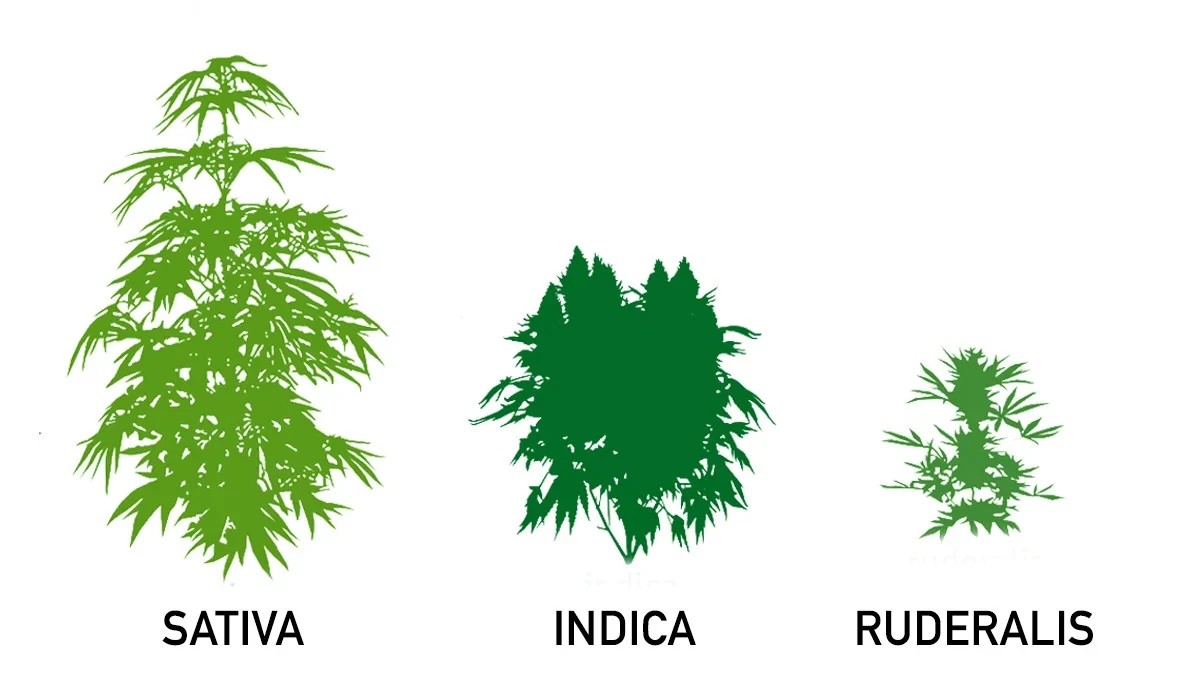
- Sativa: tall, laxly branched plants with narrow leaves
- Indica: shorter plants with a more conical shape and wider leaves
These contrasting traits are not random. They reflect each plant type’s adaptation to its native environment. Climate, altitude, and daylight patterns all helped sculpt the classic indica and sativa forms over many generations.
Cannabis Sativa
Cannabis sativa is native to warm, tropical and subtropical regions. You can find its genetic roots in countries such as Thailand, Vietnam, Colombia, Mexico, and various parts of Africa. These areas share long, hot summers, high humidity, and intense sunlight.
To thrive in these conditions, sativa plants evolved several key traits:
- Tall, upright stature that can reach well over 2–3 metres in ideal outdoor conditions.
- Large internodal spacing (the gaps between nodes on the stem), which opens up the plant’s structure.
- Long, narrow fan leaves with slender “fingers”.
- Airy, wispy buds that allow good airflow through the flowers.
These features help sativas manage heat and humidity. Wider spacing between branches and lighter bud structures reduce the risk of mould and fungal infections in wet conditions. Narrow leaves and an open canopy improve air circulation and light penetration.
Because of their height and tendency to stretch, sativa plants are often better suited to outdoor gardens or tall greenhouses. They particularly excel in regions with long summers, where they have enough time to complete their extended flowering cycles.
Growth Difference: The Flowering Stretch
One of the clearest behavioural differences between indica and sativa emerges at the start of flowering. When the light cycle changes—either naturally outdoors as days shorten, or artificially indoors by switching to a 12/12 schedule—both plant types respond, but in different ways.
Indica plants usually increase their height somewhat at this stage, but their main focus is on building a dense, compact canopy. They put energy into thick branches and heavy, solid buds that cluster close to the stem.
Sativa plants, by contrast, often undergo a dramatic “flowering stretch”. The shift in light triggers hormonal changes that cause the plant to surge upward towards the light source. In many cases, sativas can double or even triple in height during the first weeks of bloom. When grown in deep soil or large containers outdoors, some sativa plants easily reach 3 metres or more.
This tendency to stretch can be both a challenge and an advantage. Indoors, poor planning can lead to plants outgrowing the available space. Outdoors, the same trait allows sativas to tower over neighbouring vegetation and capture maximum sunlight.
Cannabis Indica
Cannabis indica traces its origins to colder, drier, and more mountainous regions such as parts of India, Nepal, Pakistan, and the broader Himalayan and Central Asian areas. These environments typically feature shorter summers, more drastic temperature swings, and less consistent growing conditions.
In response, indica plants evolved a very different growth strategy:
- Short, stocky, and conical shape, often forming a “Christmas tree” profile.
- Dense branching with tight internodal spacing.
- Broad, wide fan leaves that maximise light capture in marginal conditions.
- Thick, heavy buds with high “bag appeal” and substantial resin production.
Shorter flowering times are one of the hallmark traits of indica-dominant varieties. In regions where the warm season is limited, plants that can finish flowering faster have a big survival advantage. As a result, many classic indica lines reach maturity noticeably sooner than most pure sativas.
These traits make indicas especially attractive for indoor growers. Their compact structure fits better in confined spaces and grow tents, and their shorter bloom time allows for more cycles per year. Indica plants also respond well to training techniques such as topping, low-stress training, and ScrOG setups, making it easier to keep canopies even and productive.
Distinguishing Indica from Sativa
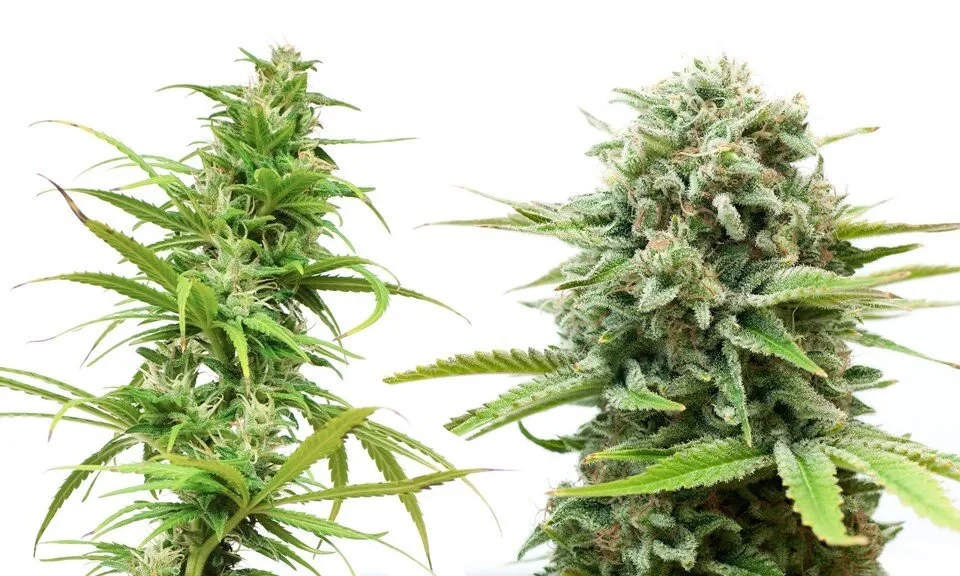
Botanical records dating back to the 18th century describe the visual differences between the major cannabis types. These differences show up in nearly every part of the plant—from leaves and stems to flowers and general architecture.
In practice, most growers and enthusiasts rely on a combination of traits to make an educated guess about whether a plant leans more toward indica or sativa. However, modern hybridisation has blurred these lines dramatically, so appearances alone are no longer a foolproof guide.
Leaf Differences
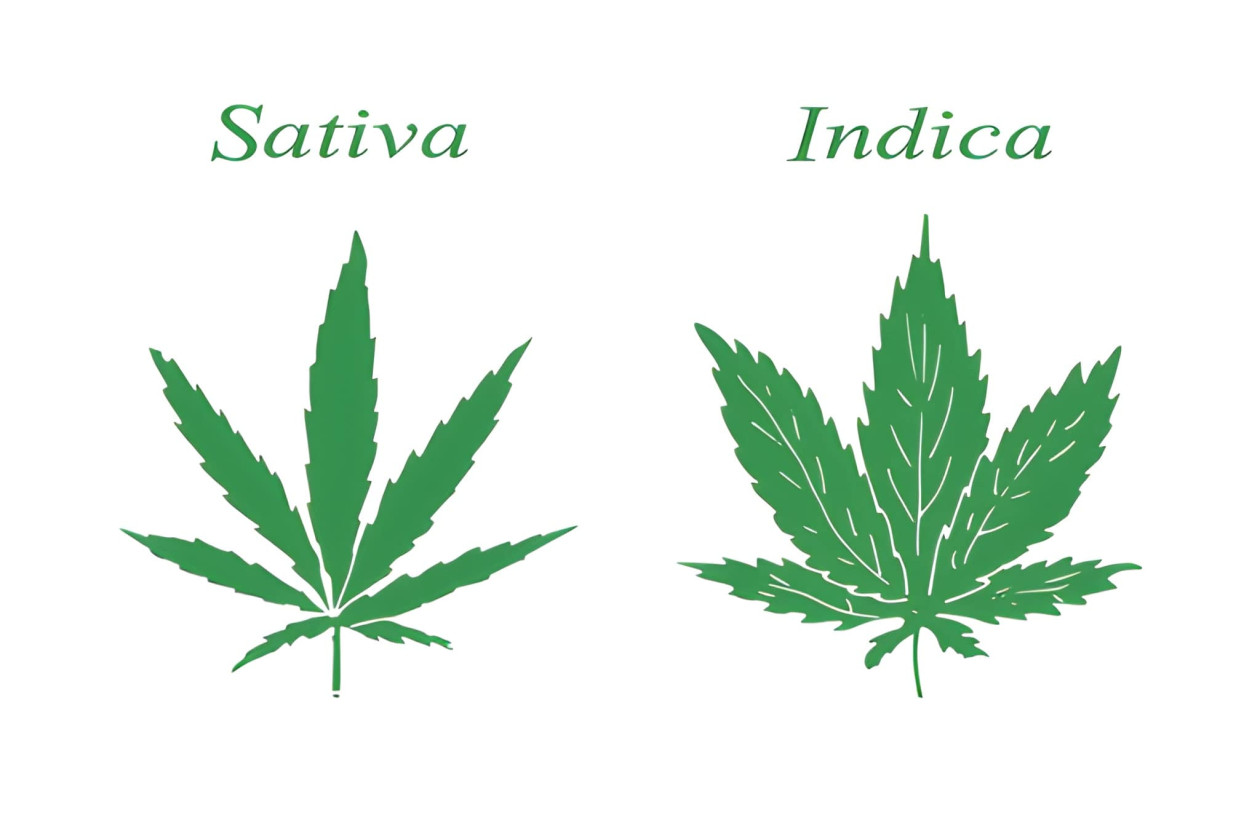
Leaves are often the quickest way to form an initial impression. Classic indica plants produce large fan leaves with broad, thick fingers. These leaves appear heavy and solid, helping to capture as much light as possible in shorter, cooler seasons.
Sativa plants, on the other hand, grow longer, narrower leaves with thin fingers and more space between them. When you look at a mature sativa canopy, it usually appears lighter and more delicate, with a lot of visible space between individual leaves.
Even from a distance, plant stature tells a similar story. Indicas tend to be squat, shrubby, and compact, hugging the ground. Sativas look taller, more open, and somewhat lanky, with branches reaching outward and upward.
Flowers Density
The flower structure of indica and sativa also differs, though this can be harder to judge with fully trimmed buds and heavily hybridised strains.
Generally speaking:
- Sativa buds are lighter, longer, and more “foxtailed” or airy. When you look into a bag of sativa flower, it may seem like there is more volume because of this lower density.
- Indica buds are usually dense, compact, and firm. They often appear smaller but heavier, with tight calyxes stacked closely together.
Because most modern strains are hybrids, many flowers show a mix of these traits. A bud might have the density of an indica but the elongated shape of a sativa, or the other way around. For that reason, it is often impossible to accurately identify a plant’s dominant type based purely on trimmed flower appearance.
Aroma and Taste
Indica and sativa categories are also often linked to different aroma and flavour profiles. These sensory qualities are driven by terpenes—aromatic molecules that give cannabis its diverse scents, from citrus and pine to fuel and spice.
In traditional descriptions:
- Indica plants are said to produce sweeter, richer flavours suggestive of honey, fruit, or dessert-like notes.
- Sativa plants are more commonly associated with earthy, woody, herbal, or fuel-like aromas.
Pure, old-school indica and sativa landraces may indeed show fairly distinct terpene signatures. However, because modern strains are so heavily hybridised, many cultivars carry complex terpene blends that defy simple categorisation. Only very experienced connoisseurs might attempt to guess a plant’s background from taste alone—and even then, it is more art than science.
Do Indica and Sativa Produce Different Effects?
Beyond how they look, indica and sativa are widely used as shorthand for how a strain feels. The common narrative goes something like this: sativa strains are uplifting, creative, and energising, while indica strains are relaxing, sedative, and body-focused.
While these generalisations can sometimes line up with user experiences, modern research suggests that they are not reliable rules. Several leading cannabis scientists argue that using “indica” and “sativa” to predict effects is overly simplistic and often misleading.
In an interview published in the journal Cannabis and Cannabinoid Research, Dr. Ethan Russo stated that labels like indica and sativa do not provide a clear picture of the chemical composition of a given plant—and therefore cannot reliably predict its effects. Likewise, Dr. Kymron deCesare from Steep Hill Laboratory has argued that these terms tell us more about morphology than about the actual pharmacology of a strain.
From a scientific standpoint, the effects of cannabis are shaped primarily by:
- The ratio and absolute levels of cannabinoids such as THC, CBD, and others.
- The terpene profile, including compounds like myrcene, limonene, pinene, and many more.
- The way these cannabinoids and terpenes interact in the body—a concept known as the entourage effect.
Two strains that both look “indica” on the surface can feel very different if their cannabinoid and terpene profiles diverge. Similarly, a plant with sativa-like growth patterns can produce surprisingly relaxing or sedating effects if its chemistry leans that way. In other words, morphology and effects do not always match neatly.
Custom Blends of Indica and Sativa
Most of the cannabis available today is not a pure indica or pure sativa, but a hybrid—a genetic blend of both types. Breeders intentionally cross plants to capture desirable traits from each side: the structure and fast flowering of indica, the flavours or high of sativa, or vice versa.
Through careful selection, breeders have created countless hybrid combinations, such as:
- Indica-dominant strains with short flowering times but more uplifting highs.
- Sativa-dominant strains that retain some compactness for indoor growing.
- Balanced hybrids that aim to provide a mix of body and mind effects.
Some research and anecdotal observations suggest that classic indica and sativa populations may differ in their typical terpene concentrations. For instance, many “heavy indica” strains are believed to contain higher levels of myrcene—a terpene also found in hops, lemongrass, mango, and thyme. Myrcene is often associated with earthy, slightly peppery aromas and deeply relaxing or “couch-lock” sensations when present at higher levels.
Yet, focusing on a single terpene or cannabinoid is still not enough to explain every effect. The entourage effect suggests that cannabinoids, terpenes, and other plant molecules interact in complex ways, shaping the overall experience more than any one component alone. This is one reason why two strains with similar THC levels can feel very different.
Indica vs. Sativa: Much More Than Meets the Eye
So, what can we honestly say about the difference between cannabis indica and sativa? On a morphological level, the distinction is real and historically well documented. Pure examples of each type show clear differences in leaf shape, plant structure, growth patterns, and geographic origin.
However, when it comes to effects, simple indica vs sativa labels are far less reliable. The way a strain makes you feel depends much more on its detailed chemical profile and your own biology than on the shape of its leaves or its country of origin. In the modern era of hybrids, the vast majority of strains combine traits from both sides of the spectrum anyway.
Still, the indica–sativa framework remains a useful starting point. It gives growers, breeders, and consumers a shared language to describe plants and to make rough predictions about growth and, sometimes, about the kind of experience a strain might offer. Used with an understanding of its limits—and complemented by information about cannabinoids and terpenes—it can still help you navigate the incredibly diverse world of cannabis.
Ultimately, the better you understand both the science and the history behind these terms, the more effectively you can choose strains that match your preferences, whether you are growing them yourself or enjoying them in your own time.