

























Blackberry Moonrocks Grow Diary and Strain Review
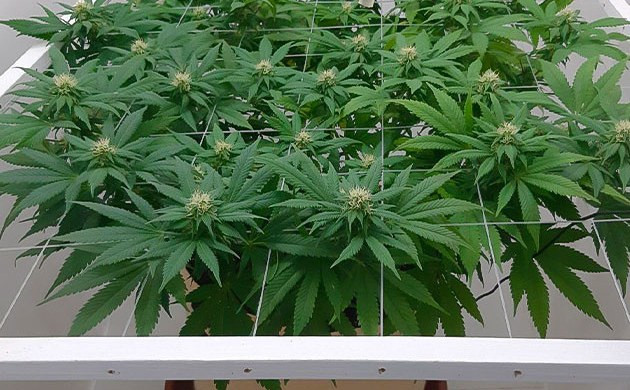
This diary follows my indoor run with Blackberry Moonrocks from AlphaFem Seeds. I called the plant Moonie during the grow, and she turned into a long photoperiod project with plenty of trimming, net work, and feeding experiments along the way.
I kept Moonie in veg longer than planned because I wanted to fill the net properly before switching the lights. By the time the schedule changed, the plant had already been through several rounds of trimming, bending, and feed adjustments.
Key Characteristics
- Seed Type: Feminized
- Flowering Type: Photoperiod
- Suitable for Growing: Outdoor, Indoor
- THC: 32%
- CBD: 2%
- Flowering Time: 56 - 63 days
- Height: 1.2m indoors (47.2 inches), 1.2m outdoors (47.2 inches)
- Genetics: Blue Moonrock x Blackberry
- Effects: Relaxing
- Flavors: Berry
Starting the Run
Grow Notes
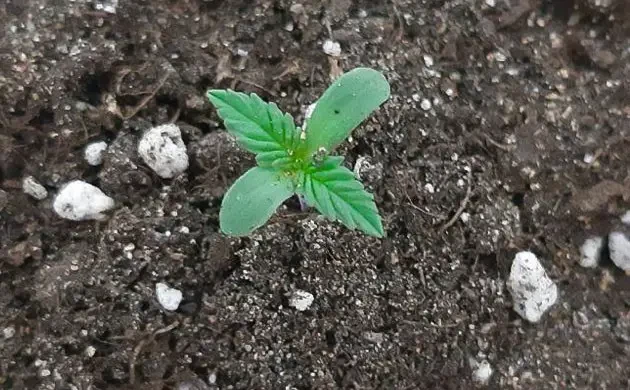
The plant started under 18/6, with the room around 23.6°C (74.5°F). Early lighting was kept modest, roughly 80W, so I wasn’t trying to push fast growth before the plant had enough roots.
Moonie moved through small containers first. I wanted the root zone to build gradually before putting her under the net and asking too much from the branches.
Week 1-2
During the first 2 weeks, the plant moved from 0.5l (0.1gal) into 1l (0.3gal). The start was calm, and I mostly watched how the young plant handled the light and the room.
The feed stayed light. At this stage, there wasn’t much to correct yet, so I kept the focus on steady early growth rather than training.
Veg Progress and Training
Week 3-4
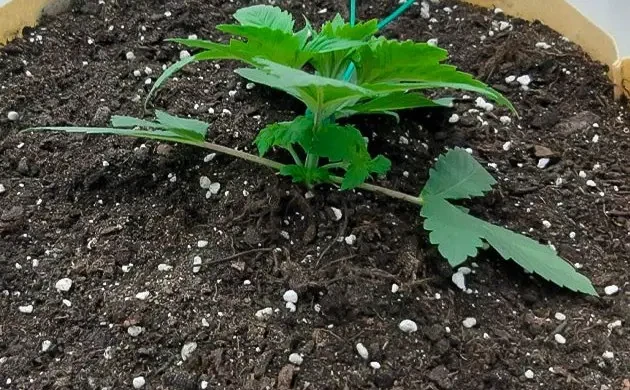
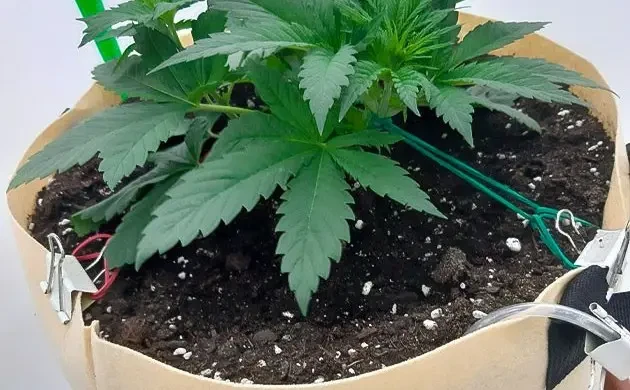
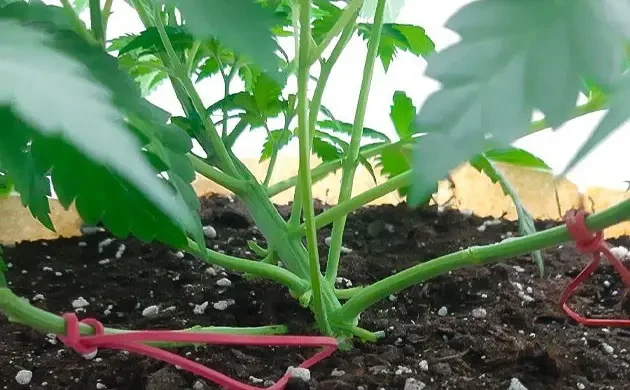
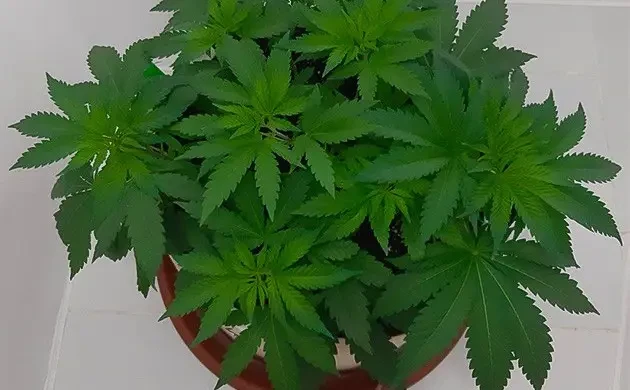
By weeks 3-4, Moonie had moved from 1l (0.3gal) into 2l (0.5gal), and I started shaping her more deliberately. I bent the central stem lower, pulled the lower branches toward the light, and tucked the bigger leaves out of the way where I could.
One watering was 2l (0.5gal), with root and carbohydrate additives in the mix. The solution was about pH 6.2 and 187 ppm. Warm weather pushed humidity up in the box, so I added more airflow and raised the lamp a little.
Week 5-6
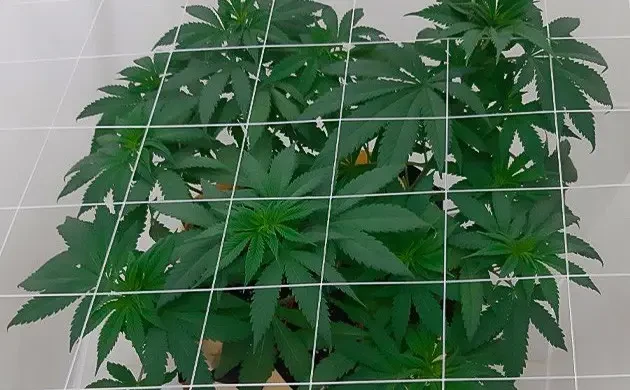
Weeks 5-6 were still fully in veg. The plant was spreading out better, but the lower growth needed regular cleaning so the future canopy would not turn into a tangled mess under the net.
Feeding became stronger here. One full-strength mix included a veg base, calcium, magnesium, and bloom-supporting minerals. I gave 3l (0.8gal) with a carbohydrate additive at pH 6.3 and 805 ppm. Humidity was lowered to 30-35%, which made the room easier to manage.
Week 7
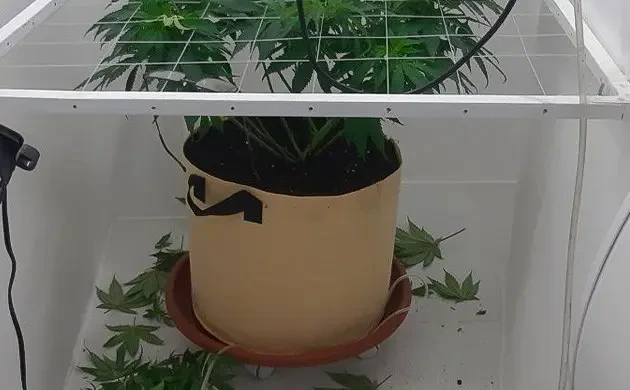
Day 45 was the important point here. I had been short on time and missed a watering, so I rolled the plant out from under the net for what turned out to be the last time.
First, I poured 3l (0.8gal) of clean water at pH 5.8. Runoff was about 750ml (25.4fl oz), with pH 6.6 and 710 ppm. Right after that, I added another 3l (0.8gal) of full veg feed with root-support and carbohydrate additives, pH 5.7 and 1450 ppm. Runoff after that was about 1650ml (55.8fl oz), pH 6.5 and 935 ppm.
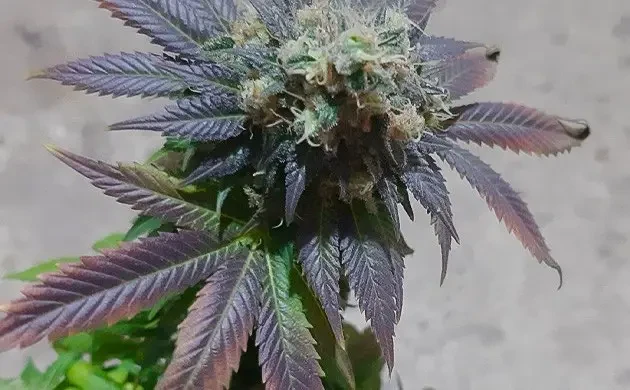
While trimming and watering, I noticed purple petioles on some leaves. I kept removing lower branches, rolled the plant back under the net, and pushed the central stem up through it.
Week 8
On day 50, I removed a bit more foliage and watered with 3l (0.8gal) of the full-strength veg solution.
By day 53, Moonie looked droopy and thirsty. I gave her 3l (0.8gal) of clean water at 80 ppm, adjusted to pH 5.8. In the photos from that visit, she was exactly 8 weeks old and still clearly in the long veg stage.
The Flip and Early Flower
Week 9
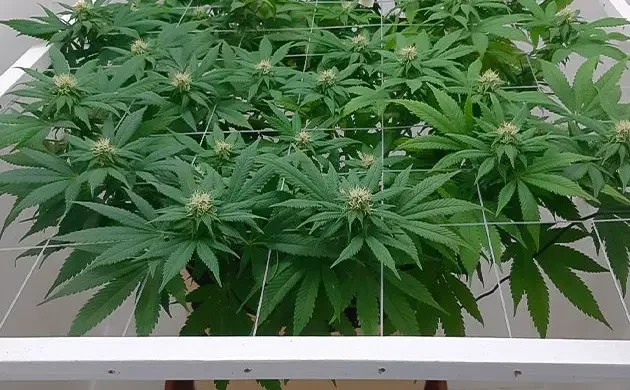
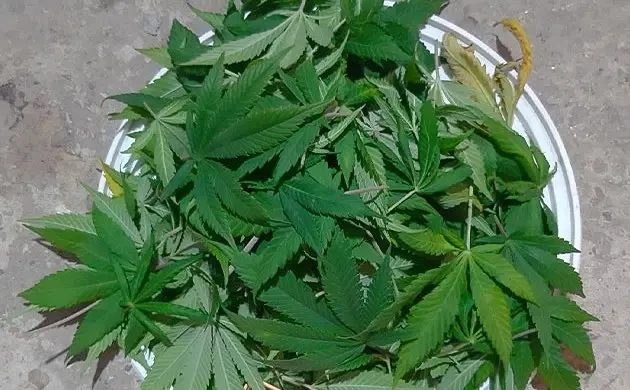
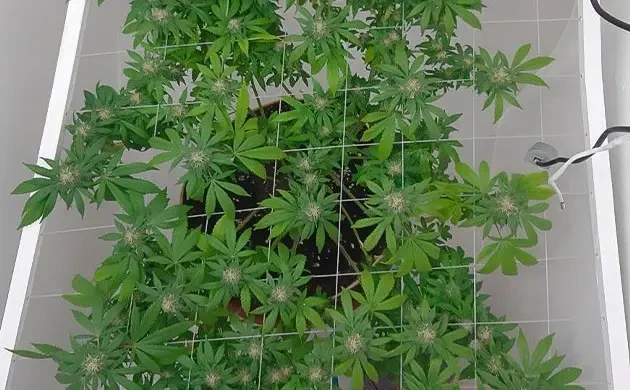
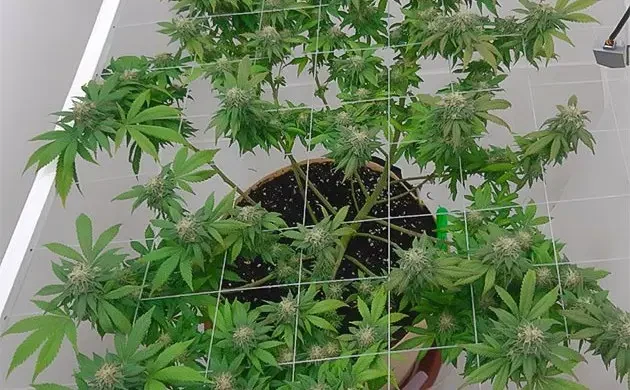
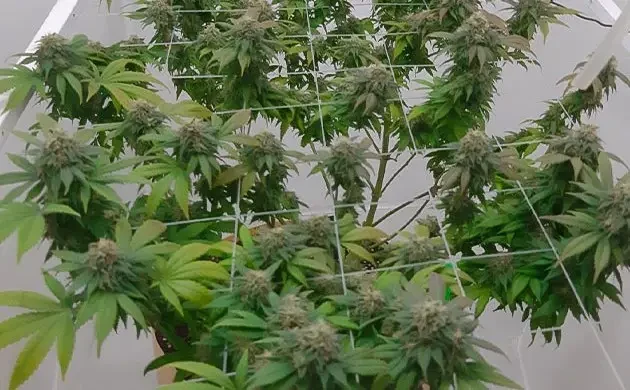
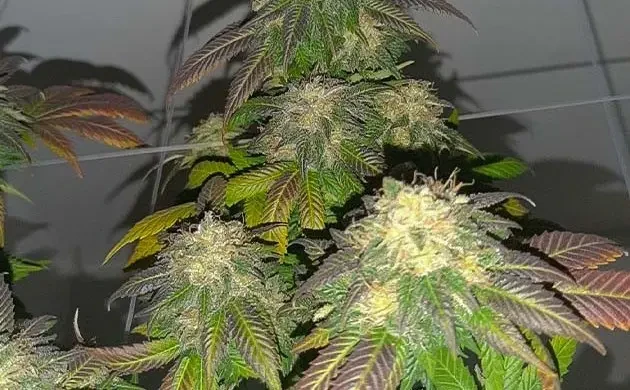
On day 58, I watered Moonie with 3l (0.8gal) of the same full veg solution as before, pH 6.0 and 1472 ppm. The next day, I stretched the branches again under the net, trying to make the canopy a little more even before the light schedule changed.
On day 60, I did a heavier defoliation and then removed all clips and elastic ties. The plant looked ready enough, so on day 61 I switched the schedule to 12/12.
The lighting changed at the same time. I added HPS and used 2 LED units in Bloom mode for extra light, with consumption around 50W. After the switch, I sprayed the plant with 0.5l (16.9fl oz) of clean water mixed with 1ml (0.03fl oz) of a recovery additive, pH 6.0. I kept the wake-up time the same, but made the night start 6h earlier.
On day 62, Moonie looked thirsty again. Some petioles were purple, and the tops seemed a little light, so I watered with 3l (0.8gal) and added 0.8ml (0.03fl oz) of sulfur. The solution was pH 6.2 and 235 ppm.
Week 10
On day 66, I gave the first bloom-oriented feeding: 3l (0.8gal) at pH 5.9 and 1422 ppm.
The mix was built around a bloom base, calcium-magnesium, sulfur, magnesium chelate, a mild booster, and monopotassium phosphate. Moonie was still in transition, but preflower had already started, so the feed finally moved away from the veg routine.
Week 11
On day 71, I watered with sulfur again, using 0.8ml (0.03fl oz) in 3l (0.8gal) of water. The solution was pH 6.0 and 260 ppm.
Three days later, I gave another 3l (0.8gal) of the earlier fertilizer solution at pH 6.2 and 1515 ppm. On day 75, Moonie had spent exactly 2 weeks under 12/12. Preflower was over by then, so I lowered humidity to 40-45%. Temperature stayed around 23-24°C (73.4-75.2°F).
Week 12
On day 78, I considered the plant properly in flower and gave a light flush with 5l (1.3gal). The water included 5ml (0.2fl oz) of a bloom enhancer and 10ml (0.3fl oz) of an enzyme product.
The solution was pH 5.9 and 115 ppm. Runoff came out at about 800ml (27fl oz), pH 6.4 and 1340 ppm. I removed a little extra foliage after that. The net was doing its job, but I was already realizing that a screened plant needs a different trimming style than what I was used to.
Late Flower and Finish
Week 13-16
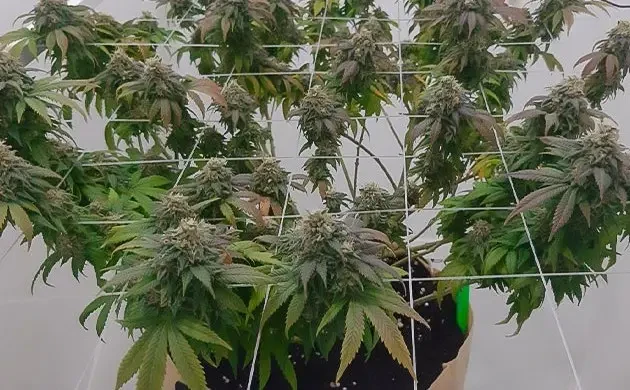
Weeks 13-16 were the calmer middle part of flower. Moonie had already been trained hard, and now the main job was to avoid overcorrecting while the flowers formed under the net.
The plant wasn’t always easy for me to read. The feeding experiments helped, but they also showed that Blackberry Moonrocks wanted a more confident nutrient plan than I had given her early on.
Week 17-18
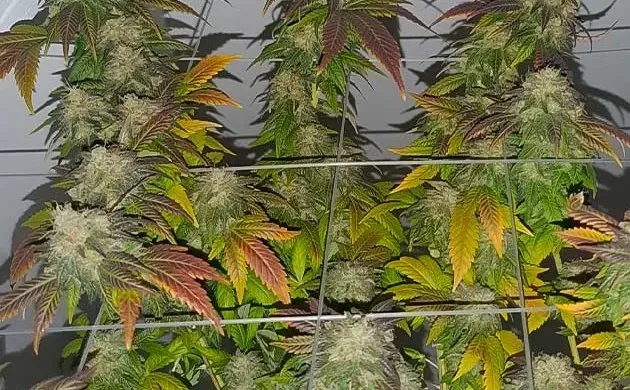
By weeks 17-18, I was thinking more about ripening than structure. The buds were there, but I could already tell the final weight would not match the strain’s full potential.
The leaves didn’t look great near the end, so the plant was not the prettiest thing in the room. Still, the flowers kept maturing, and I cared more about saving the buds than about making the canopy look clean in photos.
Week 19
On day 129, I started the week with a ripening feed: 3l (0.8gal) with a ripening additive and about half the nitrogen I would normally use. The solution was pH 6.7 and 1020 ppm.
On day 130, the plant was photographed again after I had removed the worst-looking leaves and a few that were shading lower buds. The day before, on day 129, she had already been pushed into the final ripening routine.
On day 131, I gave 4l (1.1gal) with a nitrogen source at 2ml/l (0.3fl oz/gal) and a ripening additive at 5ml/l (0.7fl oz/gal). The solution was pH 6.7 and 1350 ppm. Runoff was about 500ml (16.9fl oz), pH 6.0 and 2550 ppm.
Week 20 and Harvest
I did the final flush in week 20. On day 134, I ran 15l (4gal) with a flushing additive at 2ml/l (0.3fl oz/gal), pH 6.5 and about 110 ppm.
The first 1.5l (0.4gal) of runoff showed pH 6.1 and 1700 ppm. The last 1.5l (0.4gal) came out around pH 6.3 and 950 ppm. After that, I lowered the box to 21-22°C (69.8-71.6°F) and humidity to 25-30%.
On day 135, I poured 5l (1.3gal) of clean water at about 15°C (59°F), pH 6.7 and 90 ppm. Around 3l (0.8gal) drained out, and the first liter of runoff was pH 6.1 and 1065 ppm.
After harvest, trimming took 5h. Some of the small buds still looked nice even with burnt leaves around them. I didn’t save the leaf appearance in this run, but the buds were good enough for me to treat the grow as useful experience.
Blackberry Moonrocks Yield and Final Thoughts
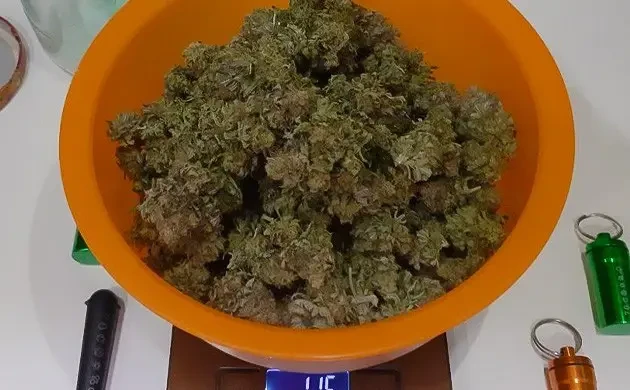
I took the smallest popcorn home from harvest to dry separately. The buds weren’t especially dense. They hung on branches at 20°C (68°F) and 50% humidity for about 4 days, then I dropped humidity to 40%. After roughly 2 more days, the flower was dry enough.
The dry buds filled about 2.5l (0.7gal) in a 3l (0.8gal) jar. The honest final weight was 116g (4.1oz). I had already taken at least 4g (0.1oz) across 2 earlier sessions, so for myself I count the run as about 120g (4.2oz) of dry, well-trimmed buds.
The quality was better than the yield. The taste came out good and soft, while the effect felt strong enough to stay around for a long time. It was a smooth body stone rather than a sharp hit.
My main takeaway is that Blackberry Moonrocks wants serious feeding if you’re chasing the advertised strength and weight. This grow gave me more useful experience than the final number shows. I tested new solutions, worked through different doses, and used a net for the first time. Next time, I’d trim differently under the screen and feed the plant with more confidence.
Herbies Head Shop expressly refuses to support the use, production, or supply of illegal substances. For more details, read our Legal Disclaimer.


- Shared on Twitter
![icon]()
- Shared on Facebook
![icon]()




Thank you for leaving a comment for us!
Your feedback will be posted shortly after our moderator checks it.
Please note that we don’t publish reviews that: